
Wayne S. Rasband Open Source Imaging Award
Overview of Award | Application Process | Recipients
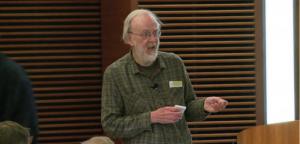
Photo of Wayne S. Rasband
Overview of Award
BINA is pleased to announce the inaugural Wayne S. Rasband Open Source Imaging Award in recognition of individuals advancing and leading efforts in open source imaging software and/or hardware where the source code or hardware plans are made freely available and may be redistributed and modified. This award is for those who embody the mission and core values of BINA by demonstrating commitment, shared values and broader support of the bioimaging community. Community contributions, in any of the areas of Community, Inclusion, and Excellence are the basis for this award.
Wayne Rasband is a pioneering open-source software developer who worked at the National Institutes of Health (NIH) for 40 years. He wrote ImageJ, arguably the most popular image processing and analysis software for bioimaging. He retired in 2010 but continues to work on ImageJ as an NIH volunteer. He fixes bugs, answers questions and adds features based on user feedback. Wayne also manages the ImageJ website and mailing list. His dedication to the community through his work on ImageJ and active participation in forums and mailing lists truly embody the values of BINA, which is why we are delighted to name this award in his honor.
Rasband developed three image analysis programs while at the NIH. The first, from the late 70s, was called “Image”. It ran on PDP-11 minicomputers, was written in Pascal, and was used to analyze autoradiographs and 2D electrophoresis gels. It had many of the capabilities we now take for granted in ImageJ, such as regions of interest, contrast stretching, thresholding and color lookup tables. “Image” did all this on computers with only 64KB of memory (images were stored in a 512×512 frame buffer/display).
Rasband started work on NIH Image in 1987 when the Mac II was introduced, with the goal of creating a smaller, less expensive and more approachable imaging system. Unlike “Image”, NIH Image was widely used outside of the NIH and it benefited greatly from suggestions, bug fixes, code and documentation contributed by dozens of users.
ImageJ came to life in 1997 when Wayne started experimenting to see if he could recreate NIH Image in Java. Java was attractive because, in theory, he could develop a program on a Mac that would “run anywhere”. ImageJ has continuously improved over many years based on user feedback and the contributions of hundreds of users.
Application process
The BioImaging North America (BINA) Wayne S. Rasband Open Source Imaging Award is designed to recognize individuals advancing and leading efforts in open source imaging in software and/or hardware where the source code or hardware plans are made freely available and may be redistributed and modified. This award is for those who embody the mission and core values of BINA by demonstrating commitment, shared values and broader support of the bioimaging community. Contributions, in any of the areas of Community, Inclusion, and Excellence are the basis for this award
Wayne S. Rasband Open Source Imaging Award benefits include:
- Travel, food, and accommodation expenses covered for attendance at the BINA Community Congress
- Recognition and award receipt at the meeting
- Presentation on awardee’s winning-work during the Community Congress program
- Invitation to the “Leadership Reception”
- Awardee’s details (name, affiliation, year awarded) listed as recipients on the Michael W. Davidson Memorial Award webpage
- $250 cash award
Award Eligibility
- The award is open to BINA members residing in North America (Canada, Mexico, United States and its territories),
- Nominees must be individuals currently working in open software and/or hardware.
- Both self-nominations and third-party nominations are allowed.
- Nominees & nominators should be current BINA members by the time of submission
- Current BINA Executive Board Members are not eligible.
- If applying to multiple awards, nominees are only eligible for one award per calendar year
Those who have received a Wayne S. Rasband Open-Source Imaging Award within the last five years are not eligible.
Note: All nominations are retained for 3 years on a rolling basis. If a nomination was previously submitted but not selected, it is eligible for 2 more years- no new application is needed.
Award Details
- Complete submission deadline: Noon PT, May 1, 2026
- Notification of outcome: No later than June 16, 2026
- All materials must be submitted by the deadline; late or incomplete applications will not be reviewed.
Nominees should demonstrate significant contributions in one or more of the following areas. Nominees are not required to address all areas.
- Community (Building collaboration and partnership to achieve shared goals in open source hardware and/or software)
- Inclusion (Fostering a welcoming and diverse environment to encourage participation and individual contributions using open source tools)
- Excellence (Working with rigor and integrity to ensure reproducible and quantitative data through open source hardware and/or software)
Items for submission
Nominations should be submitted by noon Pacific Time on May 1, 2026 deadline
- A completed nomination form
- A cover letter from the nominee (1 pg max) on why they merit the Wayne S. Rasband Open Source Imaging Award, addressing one or more of the contribution areas described above: Community, Inclusion & Excellence. Nominees are not required to demonstrate contributions in all areas.**
- Letters of support:
- A letter of support from a member of the community (the nominee’s supervisor, a prominent collaborator etc) using the following template
- One additional letter of support from a community member(s) impacted by the work of the nominee using the following template
- At least one of the letters of support must be from a current BINA member
- Letters can be supported by multiple people
**not required if self-nominated.
Successful applicants must be members of BINA by the noon Pacific time May 1, 2026 deadline and are required to attend the Community Congress awards session to accept their prize and present their community work.*
*Consideration will be given if the award winner has exceptional circumstances that prohibit them from attending the Community Congress in person.
Please contact contact@bioimagingna.org if there are any questions regarding the application process.
All materials must be submitted by the deadline; late or incomplete applications will not be reviewed.
Review Process
The Review Committee will evaluate applications in the weeks after the submission deadline, using the evaluation criteria summarized in this document. All nominees will be notified of the outcome no later than June 16, 2026.
Recipient & Nominees
See the award recipient and nominees by year:
