
Michael W. Davidson Memorial Award
Overview of Award | Application Process | Recipients
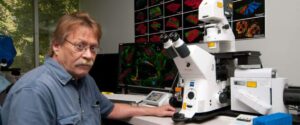
Photo of Michael W. Davidson at a Microscope (David Barfield, Florida State University)
Overview of Award
Michael (Mike) W. Davidson was a highly innovative and multi-talented researcher, who recognized the power of communicating science through images. His work and contributions to the scientific and imaging community have been an inspiration to many members of BioImaging North America (BINA), so it only seemed appropriate that BINA name an award in his honor.
Mike had a very multidisciplinary career, combining his many skills as an entrepreneur, prolific scientific researcher and dedicated mentor. Unlike many academic scientists, reliant primarily on grant funding, Mike capitalized on his love for microscopy, business acumen, and creativity, and started imaging everyday objects, such as computer chips and cocktails, creating a commercial collection of ties and scarves to fund the beginnings of his lab. Following this, he developed a series of pioneering educational websites for aspiring young microscopists, providing an introduction to optical microscopy techniques and novel technologies (https://micro.magnet.fsu.edu/micro/about.html). This was later turned into a textbook on microscopy techniques “Fundamentals of Light Microscopy and Electronic Imaging”. As an early advocate for collaboration between academia and industry, his skills in scientific communication and imaging led to long-term partnerships with many of the top microscope companies in the world, including ZEISS, Olympus and Nikon. As a scientist, Mike was passionate about the research potential of fluorescent proteins and their development and optimization. This enthusiasm fostered hundreds of collaborations with researchers around the world, resulting in over 600 scientific publications. His research focus into the use of fluorescent proteins to understand cellular organization and behavior led to the creation of thousands of fluorescently labeled cellular components. An invaluable resource to scientific researchers, this library was later donated to several academic institutions and the non-profit resource Addgene, where over 39,000 constructs have been used by scientists all around the world. However, Mike’s greatest passion was always the education of the next generation of young researchers. As a mentor, he trained over 500 young scientists across multiple areas, including scientific research, microscope development and website and graphic design.
In addition to the Michael W. Davidson Memorial Award, BINA also recognizes outstanding early-career members through the Mary Ann Booth Early Career Award. Named in honor of pioneering American microscopist Mary Ann Booth, this award celebrates emerging leaders in bioimaging who demonstrate creativity, scientific excellence, and meaningful contributions to the BINA community. The award highlights individuals within six years of their terminal degree who are shaping the future of bioimaging through research, collaboration, and community engagement. Learn more about the Mary Ann Booth Early Career Award here
Application process
The BioImaging North America (BINA) Michael W. Davidson Memorial Award is designed to support members who embody the mission and core values of BINA by demonstrating commitment, shared values and the potential for BINA leadership. Community contributions, in any of the areas of Engagement, Education, Mentorship, and Standardization are the basis for this award.
Michael W. Davidson Memorial Award benefits include:
- Travel, food, and accommodation expenses covered for attendance at the BINA Community Congress
- Recognition and award receipt at the meeting
- Presentation on awardee’s winning-work during the Community Congress program
- Invitation to the “Leadership Reception”
- Awardee’s details (name, affiliation, year awarded) listed as recipients on the Michael W. Davidson Memorial Award webpage
- $250 cash award
Award Eligibility
The award is open to BINA members residing in North America (Canada, Mexico, United States and its territories), and working in an academic setting. Current BINA Executive Board Members and corporate members are not eligible.
Note: All nominations are retained for 3 years on a rolling basis. If a nomination was previously submitted but not selected, it is eligible for 2 more years- no new application is needed.
Those who have received a Michael W. Davidson Memorial Award within the last five years are not eligible.
Award Details
Nominators should submit the following by noon Pacific Time on May 1, 2026 deadline:
- A nomination form
- A cover letter from the nominee (1 pg max) on why they merit the Michael W. Davidson Memorial Award, addressing one or more of the contribution areas described above: Engagement, Education, Mentorship and Standardization. Nominees are not required to demonstrate contributions in all areas.**
- Letters of support:
-
-
-
- At least one of the letters of support must be from a current BINA member
- Letters can be supported by multiple people
-
-
** letter not required if self nominating
Successful applicants must be members of BINA by the noon Pacific time May 1st, 2026 deadline and are required to attend the awards session at the Community Congress to accept their prize and present their community work.*
Please contact contact@bioimagingna.org if there are any questions regarding the application process.
* Consideration will be given if the award winner has exceptional circumstances that prohibit them from attending the Community Congress in person.
Review Process
All materials must be submitted by the deadline; late or incomplete applications will not be reviewed.
The Review Committee will evaluate applications in the weeks after the submission deadline, using the evaluation criteria summarized in this document.
All nominees will be notified of the outcome no later than June 16, 2026.
Recipient & Nominees
See the award recipient and nominees by year:

